The Loris Malaguzzi Center, in Reggio Emilia, Italy
Updated: May 7
Earlier this month I was fortunate enough to visit the Loris Malaguzzi centre in Reggio Emilia. I was interested in learning more about the early childhood philosophy’s approach to children’s creativity, art and learning with materials.
This post shares key ideas around the role of the ‘atelier’ in the Reggio Emilia approach. I also discuss my reflections on the Ray of Light atelier space at the centre.

The Atelier - A space for children's creative experimentation
Educators from Reggio Emilia often talk about the unpredictable nature of learning in which knowledge is formed through unexpected relationships and new connections. This understanding challenges the idea that education is a linear process of development. In Reggio Emilia preschools, the atelier is a creative studio for young children’s imagination, expression and experimentation that actively strives to encourage dynamic learning processes through the arts.
Activities inside an atelier are developed and facilitated by an atelierista, or creative facilitator who supports children’s learning through various artistic forms. These creative forms are what Reggio Emilia educators describe as the multiple ‘languages’ of learning:
“When we speak of languages we refer to the different ways children (human beings) represent, communicate and express their thinking in different media and symbolic systems; languages. Therefore, are the many fonts or geneses of knowledge” (Dahlberg & Moss, 2010).
Giving children the opportunity to learn through different artistic forms, or languages is important as mainstream education curriculum is often focused on encouraging children to learn in two singular ways: reading and writing.
The ray of light atelier
During my visit to the Loris Malaguzzi centre, I visited the Ray of Light atelier. Pictures of this can be seen above and below. My first impression walking into the atelier was of how breathtakingly beautiful the material’s selection and arrangement were. Such careful consideration had been given to how each and every object and tool had been positioned in relation to one other. The combination of natural and artificial lighting was immaculate.
The Ray of Light atelier also made me realise how the same material can take on a completely different form when presented in a different context. For example, a piece of colourful, see-through acetate looks very different on a light table to what it does on an overhead projector. These various contexts create very different invitations towards children’s experimentation.
Nearly all of the materials on display in the atelier were inexpensive or recycled objects that had been presented in exceptionally creative ways. Children’s art education experiences do not have to be expensive, but they do need to think creatively differently about how materials and tools are used to support children’s divergent learning.
What I found most inspiring in the Ray of Light atelier was the deep thought that had been put into the creative possibilities that could emerge from the interactions between the materials, tools and equipment. Children are then able to explore the potential of these interactions through their play in the space.
At the same time, I thought about the influence of the Reggio Emilia ‘atelier’ model has had on early childhood educators around the world (which is HUGE)! While I am a huge fan of the educational philosophy, I do feel concerned that some early years educators use the Reggio Children books like they are religious texts. I am not sure if the authors who originally wrote these books meant them to be used in such a way. Many other brilliant thinkers have also written on children’s learning in the arts and the significance of creativity in education. I think it is really useful to keep exploring ideas and practices relating to children’s learning in the arts that are outside of the Reggio Emilia approach. These can then be combined in new ways with the ‘atelier’ approach in preschools.

Final words
I was so grateful to have had the opportunity to visit the Loris Malaguzzi Centre. My time there was nothing short of inspirational. It also made me think a lot about the future of children’s learning with materials and how this could be expanded on beyond the discipline of visual art. Materiality is also an important part of science, technology, architecture and engineering. It is exciting to think about the partnerships that could be formed between educators and professionals exploring materials across different fields and what this could offer children’s material learning in the future.
Further reads
Vea Veechi’s book ‘Art and creativity in Reggio Emilia: Exploring the role and potential of ateliers in early childhood education?’ shares key ideas around the role of art and creativity in the Reggio Emilia education philosophy. Vea was an atelierista (a teacher with an art background) who worked in a Reggio Emilia kindergarten for over 30 years.
Carolyn Edwards, Lella Gandini and George Forman’s book ‘The Hundred Languages of Children: The Reggio Emilia Experience in Transformation’ is a very popular book with early childhood teachers around the world. This book touches on key ideas such as constructing an understanding of children as important community members, the hundred languages of learning, teaching through relationships and pedagogical documentation.
References
Dahlberg, G & Moss, P (2010). Introduction: Invitation to the dance. ‘Art and Creativity in Reggio Emilia: Exploring the role and potential of ateliers in early childhood education.’ Routledge, new york
Eamon O’Kane’s Frobel-Inspired Installation
Frederich Fröbel’s founded the first kindergarten in 1700s Germany. Since this time, his work on education has influenced many people including a myriad of teachers, artists and architects.
In this blog post, Eamon O’Kane – an Irish-born, Norway-based visual artist and Professor at Bergen University – talks about how different early childhood educators, including Fröbel, have inspired his art practice.
“We don’t stop playing because we grow old; we grow old because we stop playing.” George Bernard Shaw
“In every real man, a child is hidden that wants to play.” Friedrich Nietzsche
Can you talk a little bit about your background as an artist, an educator and now academic?
I have been working as an artist for over 20 years. For the past 19 years, I have also worked full-time in universities in Ireland, England and more recently in Bergen, Norway. I have always been interested in education and creativity. However, ten years ago I began experimenting with interactive installations and it was during this time that my interest in early chilhood and play arose. I then began working on a series of paintings entitled ‘Studio in the Woods.’ In these artworks, I drew on Modernist architecture to explore ideas of space, connectivity and social engagement. The works also drew inspiration from fairy-tales and myths. For example, the Brothers Grimm and German folk tales.

Forests, trees and wood have also been central to my creative work. While working on a series of charcoal animations a few years ago, I came across Frederich Fröbel’s work on crystals. He actually trained as a crystallographer before embarking on his studies with Pestalozzi and then inventing the Kindergarten. These animations then developed into a series that explored the relationship between the Fröbel’s Gifts and the structure of the carbon molecule. Many of these structures have a lot in common with the work of Buckminster Fuller, another kindergarten alumni.
I then developed a new body of work called ‘In all Things’ which featured wooden floors and materials including blocks, crystal shapes and sticks and spheres – all making reference to Fröbel’s Gifts and the carbon molecule.

Both of your installations 'Fröbel's Studio: A History of Play' and 'Fröbel Studio: The Institute of Creativity' have been inspired by early childhood philosophies. Can you tell us about these works and some of the main ideas that shaped them?
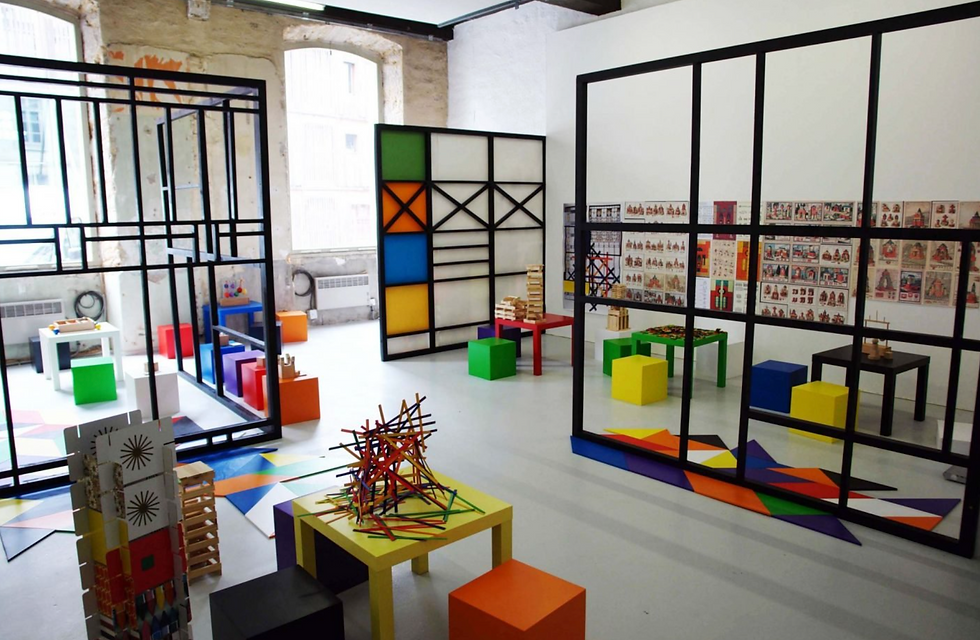
Both ‘A History of Play’ and ‘Fröbel’s Studio’ are highly interactive installations that explore Fröbel’s legacy as well as links between nature and creative development. The installations also draw attention to the link between Fröbel and Modern Art, especially in relation to his educational play materials, commonly referred to as his ‘Gifts.’ An image of objects inspired by the Gifts can be seen below.

One of Eamon O’Kane’s objects inspired by Fröbel’s Gifts. Image Credit” Eamon O’Kane
‘A History of Play’ focuses more on the historic and involves a lot of Fröbel Gifts and ideas. In contrast, ‘Fröbel Studio: The Institute of Creativity’ was developed out of ‘A History of Play’ and involves objects inspired by Fröbel’s Gifts and resources developed by other designers. In the installations, I let participants, including children, adapt and create new objects. I am happy to share that both of these installations have been exhibited around the world including in New York and Los Angeles.
How did you first come into contact with Friedrich Fröbel's work?
My first encounter of Frederich Fröbel’s work was through researching the architecture of Frank Lloyd Wright. I then became increasingly drawn to Fröbel´s work, which was no surprise as much of my childhood was spent in the forest and in the gardens of my 17th century house in Ireland. In some ways the building blocks that my childhood was comrpised of were not dissimilar to Fröbel’s or Frank Lloyd Wright.
A key moment of inspiration in relation to Fröbel’s legacy happened on a bus journey in 2008. I was travelling between my rented apartment in Odense, Denmark, to my art studio. My wife had borrowed a book from the local public library titled ’An Eames Primer’ and I was reading it on the bus. The book was written by Eames Demetrios, the grandson of Charles and Ray Eames. Through the book, I discovered that Charles Eames was expelled from studying architecture as a result of his loyalty to Frank Lloyd Wright’s vision. Similar to Frank Lloyd Wright, Eames had studied in one of America’s first kindergartens. The book also talked about how Charles Eames’ grandfather had immigrated from Limerick in Ireland to America in the 1800s. This gave me the idea for an artwork which would reconnect Eames with Limerick.

I then produced an installation that recreated aspects of the Eames’ House alongside an interactive space featuring Fröbel Gifts and furniture designed by myself. For example, I created large cubes for seating that were inspired by ‘Gift Three: the divided cube.’ The colours of the cubes were inspired by ‘Gift Deven.’ I also created some spheres and sticks that were enlarged version of gift ten.
I understand that ‘Fröbel Studio’ explores the influence Modernist artists had on early childhood education. That’s so interesting! Can you tell us more about this?
Yes, the installations take inspiration from Modernist artists, architects, and designers such as Frank Lloyd Wright, Le Corbusier, Piet Mondrian, Wassily Kandinsky, Walter Gropius, Buckminster Fuller, Johannes Itten and Charles Eames. Eames in particular frequently referred to Fröbel’s Gifts in his writings as he believed that they opened up his mind to the rhythmic structures of nature and encouraged people to see into and from within abstract ideas. From this we can see that Fröbel’s origional kindergarten from the 18th century profoundly affected the course of Modern art and architecture, as well as society more generally.
Children and their families can play in both of the installations. What kinds of things have children done with the materials? Have you seen anything that surprised you?
In the first version of ‘Fröbel’ Studio,‘ I found that providing access to the Eames films alongside this interactive ´play area´ had many surprising consequences. For example, children and adults were able to discover new ideas while simultaneously sharing their experiences. Due to the open-ended nature of the installation, participants are able to make connections between diverse and far-reaching ideas. For example, participants have made links between the invention of computers, human mortality and the universe’s origins.
Every time ‘Fröbel’ Studio‘ is exhibited I discover something new. I then try to incorporate these discoveries into future iterations. For example, I am currently preparing for a major exhibition of ’Fröbel’ Studio’at The Crawford Art Gallery in Cork, Ireland and am hoping to incorporate new experiments in that installation.

Interesting links on Eamon's work
Eamon’s website featuring a portfolio of art.
An article on Eamon’s work ‘The Mothership Project ‘at Roscommon Arts Centre. The project features the ‘A History of Play’ installation.
Information on the art exhibition ‘Broodwork” It’s about time’ at Ben Miltz Gallery, featuring Eamon’s work.
A video of Eamon’s workshops ‘Making Architecture and Animation’ run in 2017 at Bracken Education Together National School in Ireland.
Comments